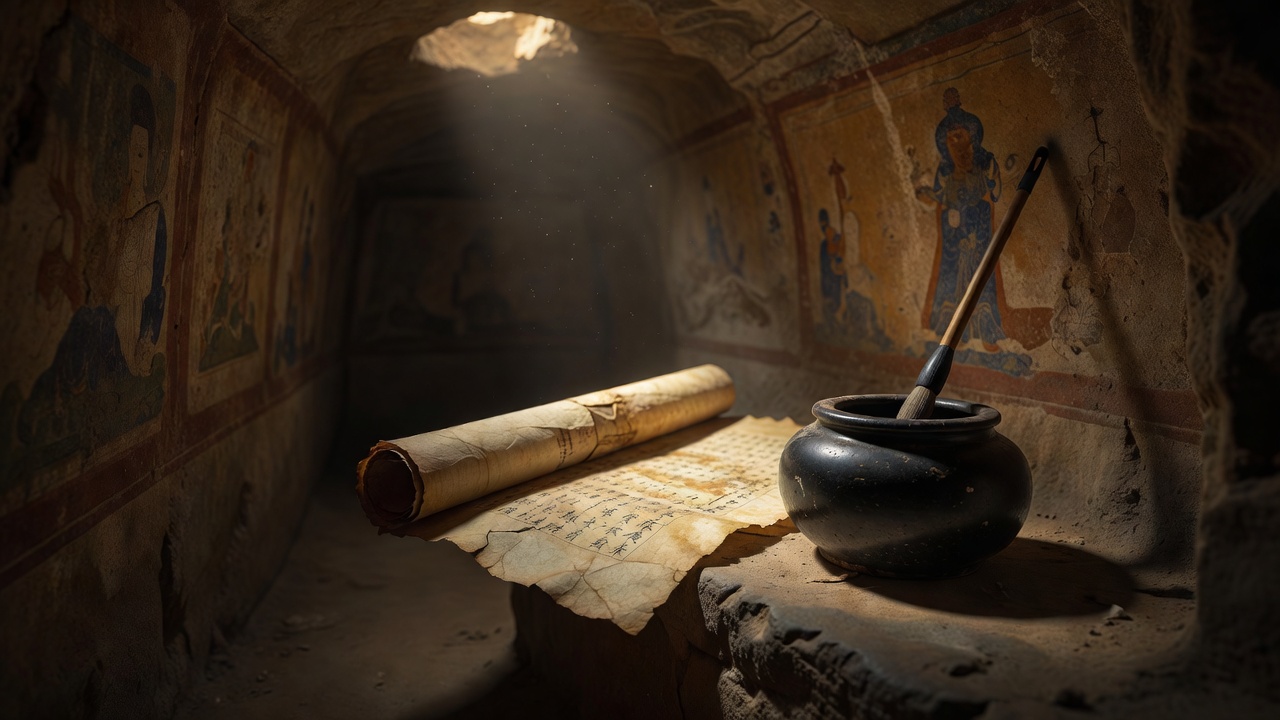
In the year 1900, a Daoist monk named Wang Yuanlu discovered a walled-off chamber hidden within Cave 17 of the Mogao complex near Dunhuang. Inside lay over 50,000 ancient manuscripts, silk paintings, and block-printed texts preserved by the bone-dry desert air.
A Polyglot Crossroad
The contents of Cave 17 represent the most diverse linguistic repository of the pre-modern world. Scrolls written in Hebrew, Khotanese, Old Turkic, Tibetan, Sanskrit, and Chinese document trade ledgers, medical prescriptions, Christian prayers, and Buddhist sutras.
"The Dunhuang Manuscripts prove that the Silk Road was not merely a trade corridor for physical goods, but an intense intellectual sanctuary where languages collided and merged."
Digital Archiving & Modern Conservation
Today, high-resolution multispectral imaging allows researchers to read faded text hidden beneath centuries of oxidized ink, unlocking new records of Silk Road history.